


 This page is regularly updated, please select here to view the latest version.
Samaras at the Rec? (October 2026)
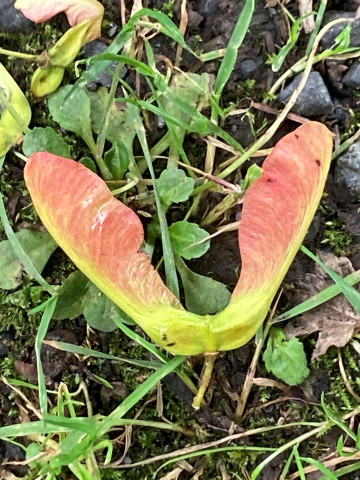
There most certainly are! And no, they're not an exotic Indian side dish, or some kind of weaponry for a Japanese fighter! They are in fact, the winged fruits of certain species of trees, one of the most common being Sycamores (Photo 1). The flat papery wings develop from the ovary wall of the fruit, and the ovary contains the seed. The fruit itself is dry and doesn't split open when ripe, so the germination of the seed takes place within, and as it grows, it forces its way out through the wall of the fruit, and hopefully takes root. Most of the samaras are formed of two fruits joined at the centre. As they develop, they dry out to the point where they separate and form two single winged units. These types of winged fruit are commonly known as helicopters or whirligigs and if you watch them spinning to the ground, it's easy to see why. As they fall, they rotate and create a tiny vortex of air over the wing, which slows their descent. This allows the wind to carry them further from the parent tree to enable them to spread, and for any nearby saplings to have the space and light to grow.
We have five tree species in the Rec that produce samaras; three are native and two have become naturalised in the UK. The three native trees are:
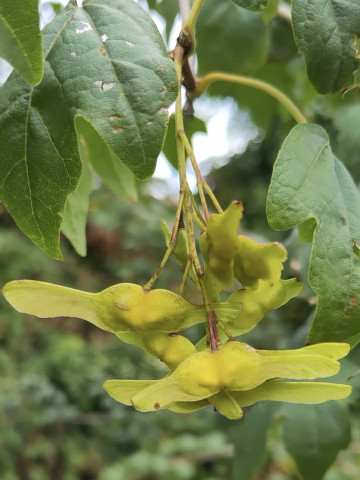
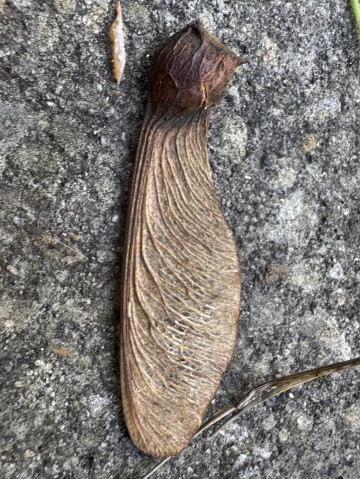
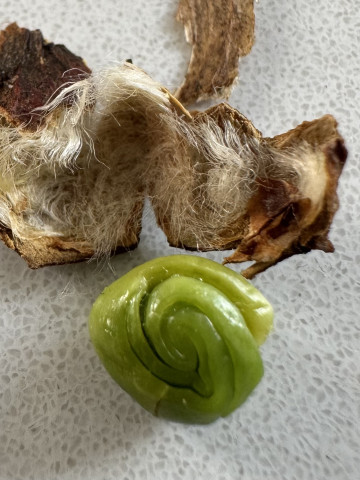
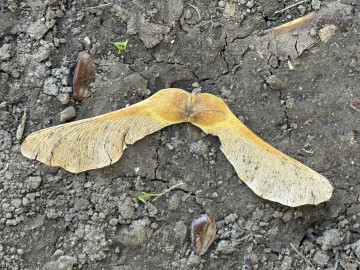
1. The Field Maple (Acer campestre). The Council planted three of these trees last November. The double samaras are distinguishable from those of other trees because the two halves form an almost horizontal line across the top, as shown in the second photo above. The photos below show firstly the desiccated single samara having split from its partner, and then the seed within. The seed appears to be already developing the embryonic root with which it would have pushed itself out from the fruit.
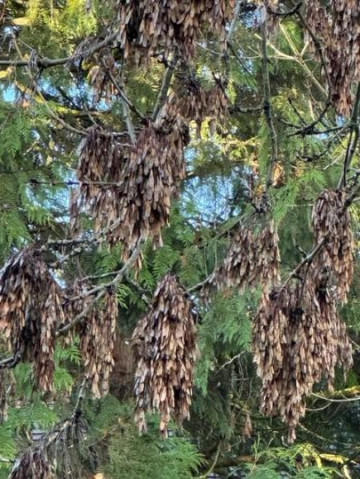
2. The Ash (Fraxinus excelsior) This tree has large bunches of single samaras that are commonly known as keys. These start out as young green fruits and at that stage, they can apparently be pickled and eaten. (I can't vouch for their taste having never tried them!) As they ripen, they turn brown and often remain on the tree long after the leaves have fallen. They usually disperse from later winter through to the spring.
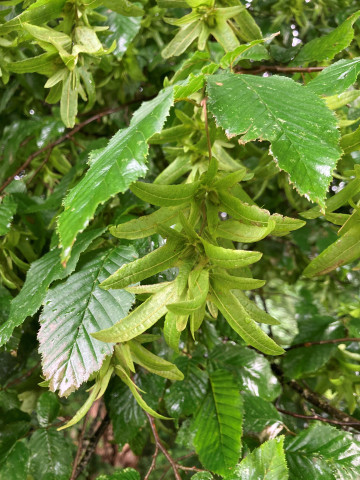
3. The Hornbeam (Carpinus betulus) As opposed to the two native species already mentioned, the hornbeam has clusters of 3 winged fruits which again turn from green to brown as they ripen. They are a distinguishing feature of the tree, especially when ripe
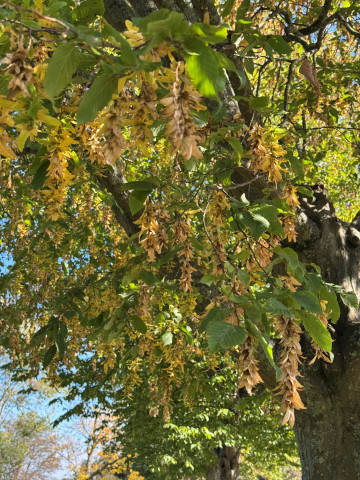
The non-native trees are:
4. The Sycamore (Acer pseudoplatanus). We do actually have a very small representative of this species at the back of the tennis courts, although it's probably not mature enough to produce fruits. Sycamore samaras are double winged and distinctly V shaped (See photo above). The samaras often have a pink or reddish hue on their wings before they ripen. The individual fruits don't always separate on falling, but will do so as they dry out. Sycamore is renowned for seeding prolifically. They grow rapidly and establish in a wide range of difficult conditions.....not traits that endear them to everyone!!
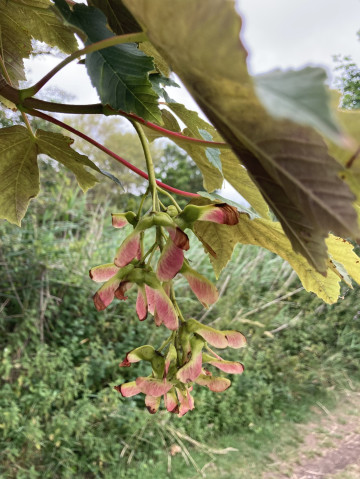
5. The Norway Maple (Acer plantinoides) This tree was introduced to the UK in the 17th century and is widely planted as an ornamental tree, but it has naturalised in some areas. This is another tree with a double samara, but in this case, the angle of the two fruits is somewhere between the 180degree Field Maple and the 90degree sycamore, and has been described as being like a coat hanger.
 <
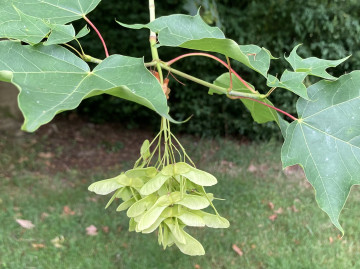
Lastly, there is a tree in the Rec whose fruits appear to have samaras. However, the Lime trees have fruits which are attached to a pale green, tongue shaped leaf called a bract. This leaf performs the same function as the samara but isn't formed from the fruit itself, being a separate botanical structure.
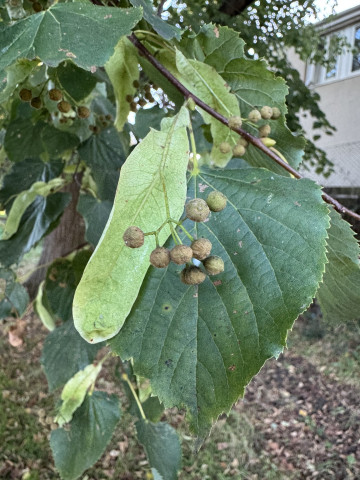
These trees rely mainly on the wind for the dispersal of their seeds, and as with so much in nature, their form is exquisitely adapted to their function.
Words and photos: Denise Long
If you're curious to know even more, the Woodland Trust's info on helicopter seeds is a must-read. You may also be interested in Southampton City Council's interactive map of the trees that they maintain, though at the time of writing it's not fully up to date.


Friends of Portswood Rec, Southampton, UK