


 This page is regularly updated, please select here to view the latest version.
Happy Hollydays (December 2025)
NATURE NOTES FROM THE REC. DEC 2025
If there's one plant that conjures up thoughts of the festive season, it has to be Holly. With its glossy green leaves and shiny red berries, it provides a splash of colour amidst the browns and greys of a winter scene. The Latin name of our native holly is Ilex aquifolium, the latter meaning prickly or pointed leaves.
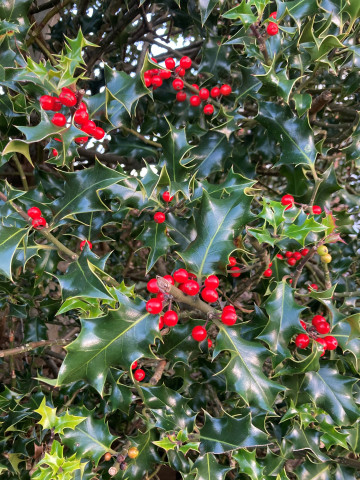
Holly has long been associated with the dark days of winter dating well back before the Christian era. It was regarded as a scared plant in the Celtic tradition and thought to protect against evil spirits and lightning. Consequently, holly was often planted near houses to protect them; a misguided belief you might think. But as is often the way with folklore, it now appears that it contains a kernel of truth. Recent scientific research has shown that the spines on Holly leaves do act as miniature lightening conductors!
Also, according to ancient mythology, the Holly King reigned over half the year, from the summer to the winter solstice, before he was defeated by the Oak King bringing in the promise of new growth and a return to spring. The character of the Holly King was sometimes incorporated into the old English mummers' plays; another tradition associated with this season of the year.
Christianity adopted many pagan customs such as that of bringing evergreens into the home during the winter. There is a belief that holly symbolises the death and resurrection of Jesus Christ. The spiny leaves of the Holly are said to symbolise the crown of thorns, the berries, Christ's blood and its evergreen nature, the promise of eternal life. In Scandinavia, Holly is actually known as the Christ Thorn.
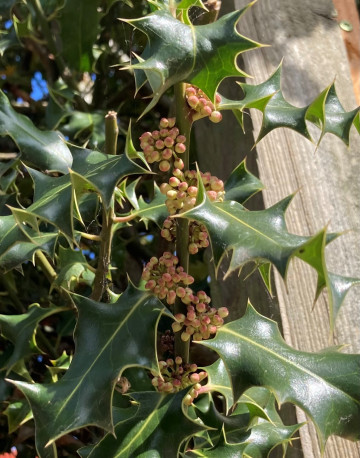
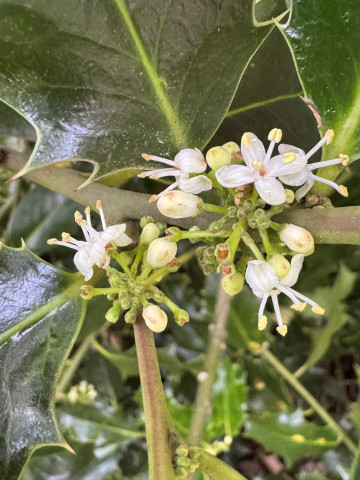
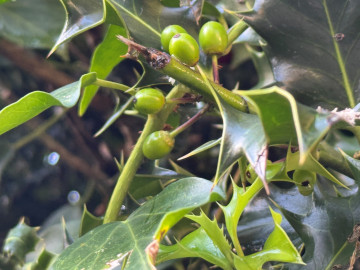
The Holly itself is dioecious which means that each plant is either male or female. It's only the female plants that produce berries, as long as they are pollinated by a nearby male. We do have some Holly around the perimeter of the Rec, but unfortunately, it's mainly male. However, SCC have recently planted 9 new trees including a female holly bush which will hopefully thrive and provide a wonderful display of berries in the future. Although berries only occur on female plants, both sexes do produce clusters of pink buds at the point where the leaves meet the stem. These bloom as white flowers, usually around late spring to early summer. Each flower has 4 petals, but whereas the male flower has 4 prominent stamens bearing the pollen (see photo), the female flower has far less pronounced stamen, but does contain a green, dome shaped centre, this being the ovary. The flowers attract insects which act as the pollinators. The berries, which are strictly speaking, drupes, begin to form in the summer, but are initially hard and green (see photo). As they ripen and turn red, they provide food for birds, who having digested them, spread the seeds through their droppings.
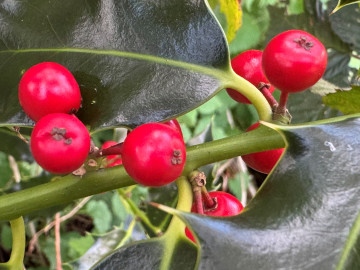
Although younger plants have the spiky leaves that we're familiar with, in older trees, especially the upper parts, the leaves can be smooth. It's thought that this is because the bush is old enough, or large enough not to need protection from browsing animals. The ability to turn different traits on or off without any changes to the DNA is known as epigenetic modification.
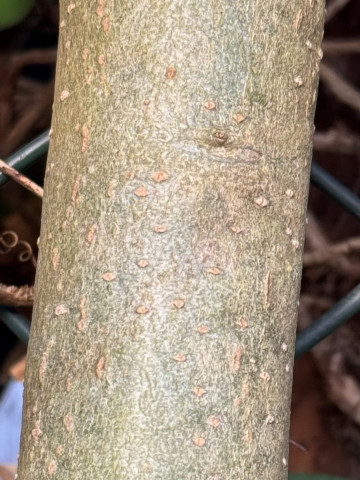
The bark of the Holly is smooth and grey, with lots of small brown warts, becoming fissured with age. The wood itself is fine grained and white. It burns slowly with a strong heat and was the original yule log.
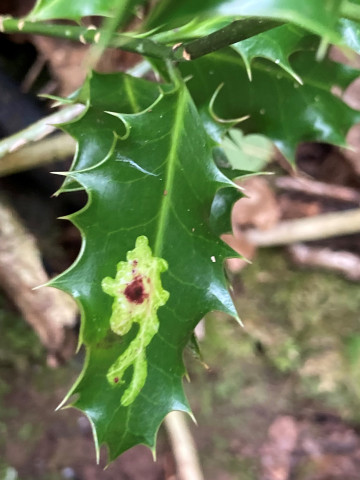
Holly provides food and shelter for a number of different animals. The berries are a vital source of nourishment for birds and small mammals, and the flowers are attractive to pollinators. The prickly leaves are generally avoided by browsers, although the smoother leaves may be eaten by deer, and in the past were harvested to feed cattle and sheep throughout the winter. There are however insects, whose larval stages feed on the leaves, including the spring generation of caterpillars of the Holly Blue and certain moth species. But the most obvious sign of insect presence is the damage left by the larvae of a tiny fly, known as the Holly Leaf Miner (Phytomyza ilicis). This larva eats its way through the leaf tissue resulting in blotches on the surface (see photo), before pupating and emerging as an adult in the spring. It may appear unsightly, but doesn't cause any permanent damage to the tree itself
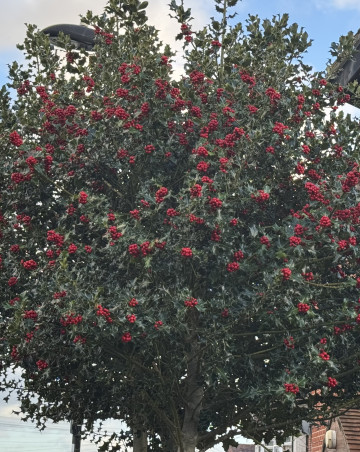
All the above photos have been taken on the Rec. However, you don't need to go far to find examples elsewhere in our streets and gardens. This very fine tree, for example, is on the corner of Shaftesbury Avenue and Welbeck Avenue.
The Holly is a wonderful native tree with a long history of symbolism, and although much associated with this season, has something to offer throughout the year.
Words and pictures: Denise Long
WISHING YOU A VERY MERRY CHRISTMAS AND HAPPY NEW YEAR FROM THE COMMITTEE OF FOPR


Friends of Portswood Rec, Southampton, UK